S&P500 Daily Action Areas & Price Targets 11/8/26
S&P500 Daily Action Areas & Price Targets 11/8/26
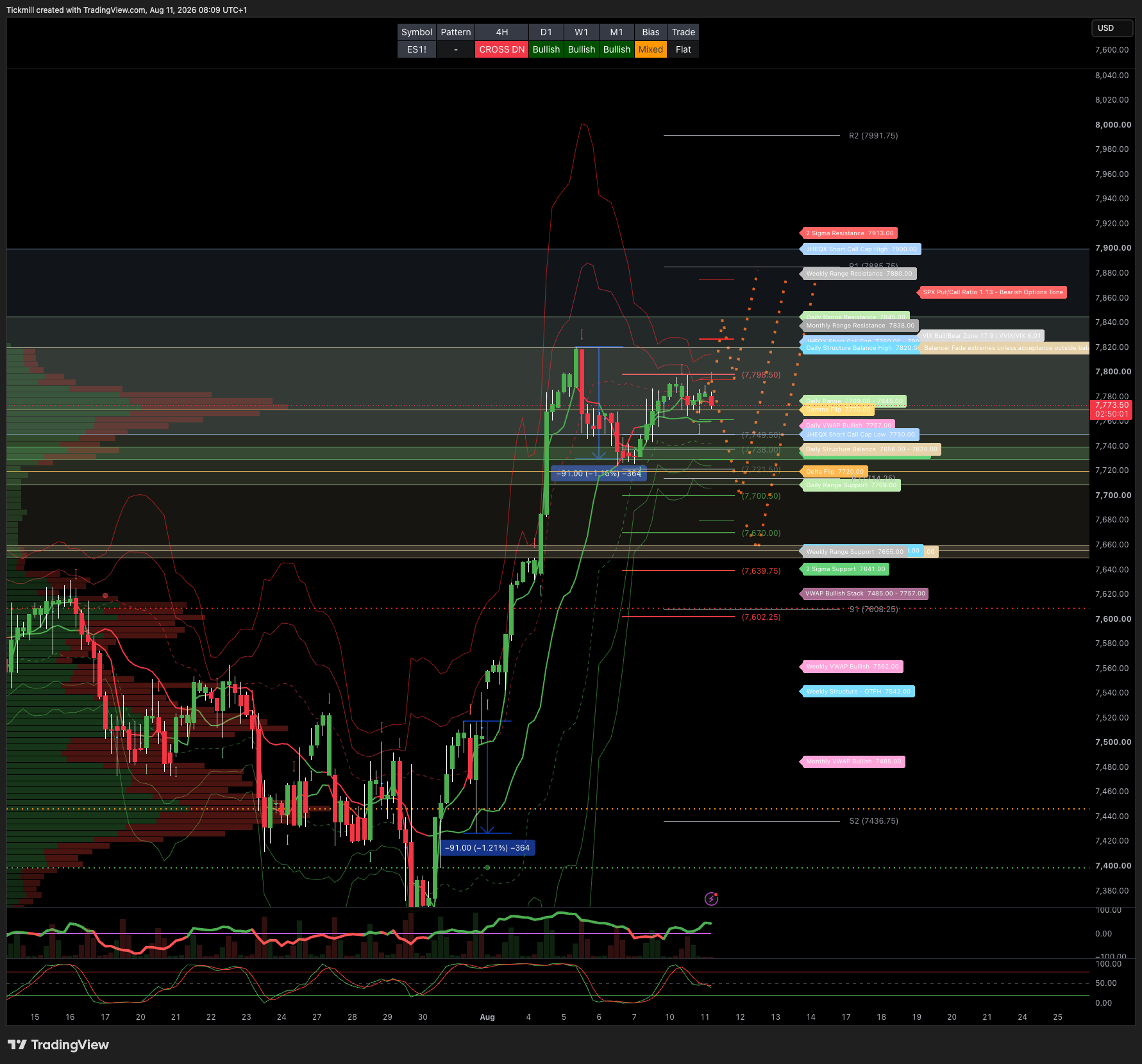
***QUOTING ES1! FOR CASH US500 EQUIVALENT LEVELS, SUBTRACT POINT DIFFERENCE***
WEEKLY BULL BEAR ZONE 7660/50
WEEKLY RANGE RES 7880 SUP 7655
MONTHLY RANGE RES 7838 SUP 7258
JHEQX Q3 Collar Short Call Cap: ~7,750 – 7,900 - Long Put Strike: ~7,050 – 7,100 (approx. 5% downside protection) Short Put Strike: ~5,950
DEC2025 OPEX to DEC2026 OPEX is 945 points giving us a range of [5889,7779]
SPX PUT/CALL RATIO 1.13 (The numbers reflect options traded during the current session.) A put-call ratio below 0.7 is generally considered bullish, and a put-call ratio above 1.0 is generally considered bearish.
GS Flow Desk: large S&P 31Aug 7000/7950 strangle in roughly $20mm vega / $115mm premium …My Read – classic “big convexity versus carry” trade: either someone paid a lot to own a wide August move, or someone got paid a lot to bet that the S&P stays comfortably inside the 7000–7950 corridor
DAILY VWAP BULLISH 7757
WEEKLY VWAP BULLISH 7562
MONTHLY VWAP BULLISH 7485
DAILY STRUCTURE - BALANCE - 7820/7656
WEEKLY STRUCTURE - OTFH - 7542
MONTHLY STRUCTURE - OTFH - 7345.75
Balance: This refers to a market condition where prices move within a defined range, reflecting uncertainty as participants await further market-generated information. Our approach to balance includes favouring fade trades at the range extremes (highs/lows) while preparing for potential breakout scenarios if the balance shifts.
One-Time Framing Higher (OTFH): This represents a market trend where each successive bar forms a higher low, signalling a strong and consistent upward movement.
One-Time Framing Lower (OTFL): This describes a market trend where each successive bar forms a lower high, indicating a pronounced and steady downward movement.
DAILY BULL BEAR ZONE 7740/30
GAMMA FLIP 7770
DELTA FLIP 7720
DAILY RANGE RES 7845 SUP 7709
2 SIGMA RES 7913 SUP 7641
VIX BULL BEAR ZONE 17.9 (VVIX / VIX) 6.01
TRADES & TARGETS
LONG ON REJECT/RECLAIM DAILY BULL BEAR ZONE TARGET DAILY RANGE RES
***ADDITIONAL SETUPS & TARGETS HIGHLIGHTED ON THE CHARTS***
(I FADE TESTS OF 2 SIGMA LEVELS ESPECIALLY INTO THE FINAL HOUR OF THE NY CASH SESSION AS 90% OF THE TIME WHEN TESTED THE MARKET WILL CLOSE ABOVE OR BELOW THESE LEVELS)
GOLDMAN SACHS FICC & EQUITY TRADING DESK VIEWS
Re-Risking, But Not Into Old Leadership — Vol Panic Collapses as Tech Exposure Gets Cut
August has brought meaningful re-risking, but the key nuance is that investors are not simply rotating back into the same AI / Tech leadership that drove the market before July. Instead, the tape shows growing interest in non-AI trades, a sharp collapse in single-stock implied volatility, and a notable bearish pivot in NDX futures positioning.
The core message:
The market is re-risking at the index level, but beneath the surface investors are reducing Tech / AI optionality and reallocating toward broader, non-AI exposure.
1. Non-AI Has Quietly Beaten AI
Over the past three months:
Basket | 3-Month Return | Volatility |
|---|---|---|
S&P 500 ex-AI Index / SPXXAI | ~+8.4% | ~11 vol |
Broad US AI Exposure / GSTMTAIP | Flat | Nearly 4x higher |
That is a striking relative-performance gap.
The non-AI trade has delivered:
positive returns
lower volatility
better risk-adjusted performance
less crowding anxiety
less dependence on AI ROI validation
The AI trade, meanwhile, has offered high volatility with little net return over the period.
The implied frustration:
AI Return≈0%,AI Vol≈4×ex-AI VolAI Return≈0%,AI Vol≈4×ex-AI Vol
That is a poor risk / reward profile, and investors are responding.
2. Re-Risking Is Happening, But It Is Broader
This is not a classic de-risking episode. August has seen investors putting risk back on.
But the re-risking has been directed more toward:
non-AI trades
broader S&P exposure
cyclicals
financials / industrials
defensives with quality characteristics
laggards outside prior leadership
potentially ex-US / EM expressions
Rather than simply adding back:
AI beta
crowded mega-cap Tech
high-vol single-stock call exposure
NDX futures longs
data-center / AI infrastructure momentum
That matters because it supports the broadening narrative, even while raising questions about the durability of prior Tech leadership.
3. Single-Stock Vol Has Been Aggressively Cut
The options market shows a major shift in how investors are treating single-stock potential.
Average S&P 500 single-stock 1-month implied volatility fell nearly:
6 vol points over the last three sessions
In the AI era, larger three-session declines have only occurred after:
August 2024 volatility shock
April 2025 tariff episode
But those were very different environments:
Episode | VIX Context |
|---|---|
August 2024 vol shock | VIX above 60 |
April 2025 tariff episode | VIX above 60 |
Current episode | VIX high only 20.88 over past month |
So this was not a macro-volatility reset after a crisis. It was a single-stock optionality reset.
That distinction is important:
The market did not move from panic to calm because macro fear collapsed from extreme levels. It moved because investors rapidly marked down the value of single-stock upside / downside optionality.
4. Tech Vol Crush Was Even More Extreme
The move was more dramatic in Tech.
Average NDX single-stock 1-month implied volatility fell:
9.1 vol points in three sessions
This suggests investors are aggressively reducing exposure to single-name Tech volatility.
Potential drivers:
disappointment with AI basket performance
post-earnings vol event passing
lower appetite for expensive AI optionality
rotation into non-AI / broader index exposure
reduced expectation of idiosyncratic upside surprises
heavy monetization of single-stock options
less demand for call convexity in crowded names
This is a meaningful change from the prior regime, where single-stock Tech optionality was central to the AI trade.
5. Vol Panic Index: From Anxiety to No Panic
The Vol Panic Index collapsed from:
7.9 in late July
to below 1
That is its lowest level since:
June 2024
In less than two weeks, the market moved from elevated anxiety to effectively no panic.
Interpretation:
July had real concern around AI unwind / momentum stress.
August re-risking has calmed the surface.
But the calm reflects lower single-stock vol demand, not necessarily renewed Tech conviction.
Investors are no longer paying up for stock-specific risk.
This is a very different type of “risk-on” environment.
6. NDX Futures Positioning Has Turned Bearish
NDX futures positioning shows an even clearer pivot away from Tech.
Exposure swung from:
+$9.9bn
to -$11.1bn
That is:
a US$21bn swing
the largest weekly decline
the most bearish reading since ChatGPT launched in 2022
This is one of the most important points in the note.
The equity market can be rising while Tech exposure is falling if investors are:
rotating into SPX ex-AI
buying equal-weight / broader baskets
favoring cyclicals
buying non-US equities
reducing NDX beta
hedging AI longs
expressing risk via less crowded sectors
So the index-level rally masks a significant internal rotation.
7. Market Implication: Bullish Breadth, Bearish Tech Skepticism
The note creates a two-sided interpretation.
Constructive Interpretation
The market is broadening.
Positive signs:
S&P ex-AI outperforming
index-level re-risking
vol panic collapsing
non-AI trades gaining attention
lower concentration risk
potentially healthier market leadership
This supports the idea that the bull market is becoming less dependent on AI.
Cautious Interpretation
Tech / AI conviction is fading.
Warning signs:
broad US AI exposure flat over three months
AI vol much higher than ex-AI
single-stock vol exposure being cut aggressively
NDX futures positioning most bearish since 2022
investors skeptical of Tech upside optionality
potential for AI leadership to lag even if SPX rises
This supports the idea that the market is no longer willing to pay up for AI optionality without stronger monetization evidence.
8. Relationship to the Current Tactical Bull View
This does not necessarily contradict a tactically bullish view on equities.
It actually reinforces the idea that the equity rally may continue through:
broader participation
cyclicals
financials
industrials
healthcare
ex-AI growth
non-US / Asia ex-Japan
EM ex-AI
But it complicates the idea of a simple Mag7 / AI rebound.
The current market is saying:
Risk-On≠AI-OnRisk-On=AI-On
or:
SPX Can Rise While NDX / AI Leadership LagsSPX Can Rise While NDX / AI Leadership Lags
That is the major tactical nuance.
9. Options Market Read: Lower Vol Can Support Spot, But Reduces Convexity
The collapse in single-stock vol has mixed implications.
Bullish
Lower implied volatility can:
reduce hedging costs
support risk appetite
encourage systematic re-risking
signal less panic
help dealers stabilize markets
support carry strategies
Bearish / Cautionary
But it can also mean:
investors are no longer willing to pay for upside optionality
single-stock dispersion opportunities may be underpriced
complacency is rising
future shocks may be less hedged
Tech upside may require actual earnings / guidance catalysts, not just positioning
In Tech specifically, lower vol means the market is assigning less value to idiosyncratic upside.
10. Why This Matters Before CPI, NVDA, and Jackson Hole
This shift is happening just before major catalysts:
CPI
PPI
Retail Sales
NVDA earnings week of Aug 24
Jackson Hole
The market has moved from anxiety to calm quickly, while NDX futures positioning has turned sharply bearish.
That means catalyst reactions could be amplified:
If CPI Is Benign
yields fall
broad equities rally
Mag7 could squeeze if shorts are too extended
low vol may encourage call buying
NDX underpositioning could become fuel
If CPI Is Hot
yields rise
Tech underperforms
bearish NDX positioning may be validated
low vol could reprice sharply higher
single-stock vol reset could reverse
If NVDA Delivers
AI skepticism could unwind quickly
NDX shorts could cover
AI baskets could catch up
single-stock Tech vol may reprice higher
If NVDA Disappoints
Tech skepticism deepens
AI underperformance extends
broadening may continue, but index concentration risk rises
NDX could lag materially
11. Tactical Portfolio Takeaways
1. Keep Equity Exposure, But Broaden It
The market is re-risking, so being too defensive may be costly. But the re-risking is not concentrated in prior AI leadership.
Prefer:
S&P ex-AI
equal-weight exposure
quality cyclicals
financials
industrials
healthcare
select software
non-US / Asia ex-Japan
EM ex-AI
2. Be More Selective in AI / Tech
AI is no longer being rewarded as a monolithic basket.
Prefer:
hyperscalers with clear backlog / ROIC support
names with earnings visibility
software showing AI monetization or resilience
infrastructure beneficiaries with realistic valuation support
Be cautious on:
high-vol AI concept names
crowded single-stock option trades
names dependent only on multiple expansion
lagging semis without earnings support
3. Watch NDX Positioning for Squeeze Risk
The move to -$11.1bn NDX futures exposure is very bearish. If CPI is benign or NVDA validates the AI thesis, this could create a sharp squeeze.
4. Low Vol Means Hedge Opportunistically
With the Vol Panic Index below 1, hedges are cheaper. Investors should consider using low implied vol to add protection ahead of:
CPI
PPI
Retail Sales
NVDA
Jackson Hole
Bottom Line
August has seen strong re-risking, but not back into the same pockets that led before July. Over the past three months, the S&P 500 ex-AI Index has returned around 8.4% on only 11 vol, while broad US AI exposure is flat despite being almost 4x more volatile. That poor AI risk / reward is now showing up in options and futures.
Average S&P 500 single-stock 1-month implied vol fell nearly 6 points in three sessions, while average NDX single-stock 1-month implied vol fell 9.1 points. The Vol Panic Index has collapsed from 7.9 in late July to below 1, its lowest since June 2024. This was not a macro panic reset — the VIX only reached 20.88 over the past month — but a major repricing of single-stock optionality.
Most strikingly, NDX futures exposure swung from +$9.9bn to -$11.1bn, the largest weekly decline and most bearish reading since ChatGPT launched in 2022. The market is re-risking at the index level, but investor skepticism toward Tech / AI has risen sharply.
The tactical implication is clear: stay constructive on equities, but broaden exposure. The rally can continue, but it may be led by non-AI, cyclicals, financials, industrials, healthcare, and ex-US / EM expressions rather than the old AI leadership alone.
Disclaimer: The material provided is for information purposes only and should not be considered as investment advice. The views, information, or opinions expressed in the text belong solely to the author, and not to the author’s employer, organization, committee or other group or individual or company.
Past performance is not indicative of future results.
High Risk Warning: CFDs are complex instruments and come with a high risk of losing money rapidly due to leverage. 69% and 73% of retail investor accounts lose money when trading CFDs with Tickmill UK Ltd and Tickmill Europe Ltd respectively. You should consider whether you understand how CFDs work and whether you can afford to take the high risk of losing your money.
Futures and Options: Trading futures and options on margin carries a high degree of risk and may result in losses exceeding your initial investment. These products are not suitable for all investors. Ensure you fully understand the risks and take appropriate care to manage your risk.
Patrick has been involved in the financial markets for well over a decade as a self-educated professional trader and money manager. Flitting between the roles of market commentator, analyst and mentor, Patrick has improved the technical skills and psychological stance of literally hundreds of traders – coaching them to become savvy market operators!